

Consistent and targeted deterrence works
Road traffic: reliable drug screening
Most road traffic accidents are caused by people disregarding the rules. This primarily means speeding or being under the influence of alcohol or illegal drugs. Numerous scientific studies have shown that controls and penalties act as deterrents. Sufficient levels of consistent traffic surveillance by the police and local authorities are key to this.
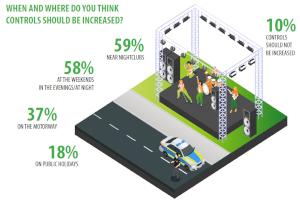
The Germans want more road traffic controls: this was the finding of a survey on traffic controls conducted by the petrol station chain HEM in February 2022 involving 2,383 participants aged 18 and over. Source: Deutsche Tamoil GmbH, Hamburg
An instant 13-percent rise in speed violations after it was publicised that the previous speed checks were no longer in place – this depressing record was logged by a local authority that took part in a study on the effects of increased traffic checks. This does not happen everywhere that checks are suspended but several studies have shown that the educational effects diminish within less than 18 months if no further checks are imposed.
The effectiveness of road traffic checks depends on multiple individual factors and their combination. However, experts agree that the probability of being caught is one of the main decisive factors. There is also the threat of a fine that is regarded as high. Here, the perception of fines depends on people’s income and social situation, for example. A meta-study conducted in 2016 showed a 15% decline in all offences as a result of a 50% to 100% fine increase and no effect on offences in the case of an increase of less than 50%. Fine increases reduced the number of fatal accidents by up to 12%.
The threat or possibility of losing a driver’s licence reduced the number of accidents by 17% and the number of offences by 20%. The greatest reduction was seen when the loss of a driver’s licence was combined with measures such as rehabilitation programmes or vehicle confiscation. The rapid enforcement of fines also has a positive effect in terms of deterrence.
Whether in relation to speed, rules such as wearing a seatbelt or the influence of alcohol and drugs, consistent, regular and, above all, sufficiently frequent controls result in better compliance with regulations. Various surveys have shown that the majority of road users are even fully in favour of these. The level of fairness with which the controls are performed and whether the controllers use recognised, reliable methods have also been proven to play a part. Appropriate equipment for the police, authorities and municipalities is therefore all the more important.
Latest study from Australia
In December 2021, an Australian study was published that looked at roadside drug testing as a deterrent. The findings were as follows:
- The risk of being caught is not high enough to achieve a change in behaviour.
- To act as a sufficient deterrent and instigate a change in behaviour, road users must at least witness the performance of a roadside drug test more than once a year.
- Being present during such testing is a sufficient deterrent. People do not have to be tested themselves.
The following conclusions were drawn:
- More tests need to be performed if they are to act as a deterrent.
- Drug testing should be as visible as possible, e.g. on busy roads. This should have an additional deterrent effect.
These findings reconfirm older studies, which came to the same results.
THINK! – a British government campaign against drug driving
The British government has been conducting highly successful road safety campaigns for over 75 years. With a budget of 2 million pounds, the campaign against drug driving was one of the most extensive. The primary target group comprised young men aged between 17 and 34. To reach these, the campaign increasingly ran on social media. There were 7 million YouTube views of the film ‘Paranoia’ and 18 radio adverts reached 61% of the target audience. 600 posters were also displayed in pub and club toilets. The result: 52% of the targeted audience saw a campaign image at least once. The warning messages therefore reached an above-average number of road users.
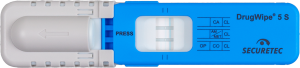
The DrugWipe® product portfolio offers
rapid screening drug tests for testing saliva and surfaces –
simply contact us; we’re always happy to help!
References:
Bundesanstalt für Straßenwesen BAST, Bergisch Gladbach; Australasien College of Road Safety, Collett Place, Pearce ACT 2607; Deutsche Tamoil GmbH, Hamburg; Polizei Brandenburg „Konzeptionelle Verkehrssicherheitsarbeit – Ausgewählte Aspekte wirkungsorientierter Verkehrsunfallbekämpfung”; Gesamtverband der Deutschen Versicherungswirtschaft e. V. (German Insurance Association), Berlin, „Regelverstöße im Straßenverkehr – Häufigkeit, Schadenfolgen, Sanktionierung, Prävention” (‘Road traffic offences – frequency, consequences, sanctions and prevention’); Journal of Safety Research 80 (2022), „Do they need to be tested to be deterred? Exploring the impact of exposure to roadside drug testing on drug driving”, sciencedirect.com; Global Road Safety Partnership, Genf, „A Guide to the Use of Penalties to Improve Road Safety”; European Monitoring Centre for Drugs and Drug Addiction EMCDDA, Lissabon, emcdda.europa.eu ; „A breathalyser for drugs”,British government campaign, think.gov.uk, THINK! campaign marketing plan
Images provided by:
Securetec Detektions-Systeme AG; AdobeStock 251219306


