
The Drug Market in the Pandemic
Surprisingly flexible
Amongst the many impacts of the coronavirus pandemic are those on the global drugs trade and consumption behaviour. Many experts were surprised at the speed and flexibility with which both users and dealers adapted to the new situation.
After the first three months, various studies showed a distinct slump in the drug trade and drug-related activity. Lockdowns and tougher policing combined to make street dealing more difficult. Drug-related crime was disrupted as opportunities for small-time robbery and pickpocketing almost vanished. For many, money to buy drugs became scarce. From the sellers’ perspective, the illegal trade was hit hard by tight border controls and general travel restrictions.
The response to these changed conditions was quick to be seen. The biggest change was in the smuggling routes. Drug producers increasingly switched, successfully, to cargo vessels. Popular hiding places were, and are, medical products and toiletries.
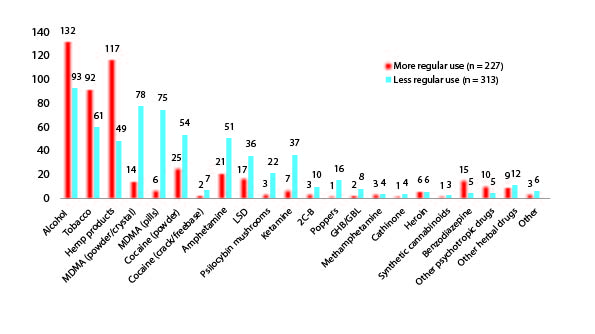
The chart shows changes in drug use in Switzerland since the outbreak of COVID-19. Experienced users consumed alcohol, tobacco and hemp products more frequently, while stimulants such as MDMA or cocaine were used less often. The figures were reported by Infodrog, the Swiss Office for the Coordination of Addiction Facilities, in Bern. Source: Infodrog, Bern
Street trade was increasingly replaced by the dark net and so-called “dead drops”, secret stashes where dealers hide drugs and customers pick them up. Even before the coronavirus, it was clear that the drug trade was increasingly turning to service activities, for example deliveries. This type of selling also saw an upturn. It also makes use of conventional channels such as postal and courier services.
Around the world, a number of studies show a sharp increase in cannabis consumption. A Canadian study¹ revealed a 20% increase in use, while the consumption of experienced users in Switzerland more than doubled. In France, 19% of users were even smoking in the mornings².
Relatively easier buying and low prices were both playing their role in this. In contrast, there was a large drop-off in stimulants such as cocaine and amphetamines, as clubs and other opportunities to party where it is common to use and deal in these drugs closed down and stayed closed.
Reduced quality creates more risks
Restricted international transport options led to another problem. There is a shortage of raw materials for manufacturing drugs. For consumers, both the switch to lesser quality substitutes and drug adulteration pose new health risks.
There is no doubt that exceptional circumstances such as lockdowns make people worry much more – about their future, finances and family. As a result, there is increased abuse of all types of drugs and medications. Having to stay at home and boredom also lead to an increase in drug use. Many of the respondents said that they were using more drugs simply because the opportunity was there.
Border closures and lockdowns have not been accompanied by a reduction in drug use and drug smuggling. The scene is creative.
Changes to substitution programmes
Around the world, many charities and contact points for drug users have also had to close during the pandemic. For addicts who depend on drug substitutes this has often caused serious bottlenecks with negative impacts. In some countries, for example the USA, the Netherlands, Israel, Lebanon and Morocco, the dispensing criteria have been relaxed and those affected have been given drug substitutes for a longer period. At the moment there are substitutes for 7 days instead of 5 in Germany, too.
More drivers arrested for drug use
In some countries, lockdown has seen an increase in the number of people driving who were arrested for being under the influence of drugs. The UK, the USA and Ireland, for example, have recorded far more arrests than before the virus. Police in the UK have predicted that drug driving might in the future overtake drink driving3. Essex Police have said that most convicted drivers had a criminal background4. A young man in Leicester, UK, had particularly bad luck in January5. Despite lockdown, he wanted to go for a drive with his girlfriend, and he was stopped and tested. He was identified as having taken drugs. So a pleasant spin turned into an arrest and the loss of his driving licence.
DrugWipe® – mobile saliva and surface tests for reliably detecting drugs on the roads and at customs. We would be happy to provide you with detailed information.
References:
1Self-isolation: A significant contributor to cannabis use during the COVID-19 pandemic; S. J. Bartel , BA, S. B. Sherry , Phd & S. H. Stewart , Phd; Pages 409-412 | Published online: 12 Oct 2020; https://doi.org/10.1080/08897077.2020.1823550
2https://www.ofdt.fr/BDD/publications/docs/eisxab2ac.pdf
3Expert warns drug-driving `could soon excceed‘ drink-driving, BBC.com, 20.06.2020
4Record Drug Driving Arrests, Essex Police UK, News May 2020
5Motorist ‘out for drive‘ stopped for possible Covid-19 breach is then arrested over drug driving, www.leicestermercury.co.uk, 11.01.2021
Impact of COVID-19 on drug markets, drug use, drug-related harms and responses in south European Neighbourhood Policy area; EMCDDA trendspotter briefing December 2020
Impact of COVID-19 on patterns of drug use and drug-related harms in Europe; EMCDDA trendspotter briefing June 2020
Image source: Securetec AG; Fotolia AdobeStock 203187963


