The Magic Mushroom Revival
The dark side of a “natural” high
While magic mushrooms cannot be considered genuine competition for LSD, they enthral their devotees with a similar effect. Psychoactive mushrooms are currently enjoying increasing popularity. Despite the significant risks associated with their consumption, uncertainty surrounding long-term negative effects and the fact that they are illegal in most countries, the number of their advocates is rising, albeit at a low level. The overall prevalence1 of LSD and magic mushrooms is less than 1% in the EU.
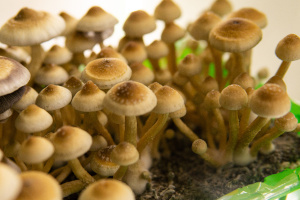
Kits for growing magic mushrooms “at home” are banned in Germany but can be ordered in the Netherlands.
There are 186 varieties of mushroom worldwide that are known to have hallucinogenic effects. Most belong to the genus Psilocybe (Latin for “bald head”). The best-known psychoactive mushroom is the liberty cap.
All these mushrooms have a similar effect. They contain two substances, psilocybin and psilocin, that are responsible for their psychedelic or hallucinogenic effect.
Psilocybin itself is not psychoactive and is only converted into active psilocin in the body after it has been ingested. Psilocin is similar to the neurotransmitter serotonin, the “happy hormone” that is produced naturally in the brain. This similarity allows psilocin to dock at certain serotonin docking sites in the brain and activate them.
Effect
Mushrooms are usually eaten in dried form. In some cases, they are smoked or processed into biscuits, honey or chocolate. However, they can also be consumed raw.
It can take up to 40 minutes for the effect to kick in. Until this happens, the user experiences twitching in the arms and legs, feelings of warmth and giggling fits. The rush that then occurs may last for up to six hours, with the experience ranging from stimulating to intensely hallucinogenic. Bad trips are very common, even if magic mushrooms are used in safe environments and if the user is in a good emotional state. Perception is altered across all sensory channels (sight, sound, smell, taste, touch). The effects trigged by psilocybin/psilocin are comparable with those of LSD. However, mushrooms take effect more quickly and the effects are more short-lived. The come-down is also faster and is generally less unpleasant.
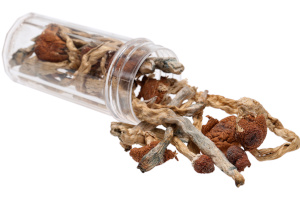
Edible dried mushrooms
The strength of the effect depends both on the mushroom itself and on the user’s mood. Mushrooms, as a natural product, are not standardised, and so each mushroom may have a different concentration of psilocybin. The risk of an overdose is very high. It appears that psilocybin does not cause physical or psychological dependency. However, it has been observed that a small degree of tolerance develops with long-term consumption, leading users to increase the dose.
There are no rapid screening tests to detect whether a person has consumed psilocybin. Time-consuming laboratory testing is required to prove consumption. Tests to detect psilocybin are not routinely performed as part of roadside screening or in similar situations. If consumption is suspected, a laboratory test is ordered.
Those who know what they’re doing can pick their own mushrooms in autumn. However, this entails a high risk of picking the wrong species. At best, this means that nothing happens because a harmless mushroom is consumed. At worst, the user may succumb to fungus poisoning.
Contrary opinions
Mushrooms containing psilocybin first became popular after an article on them appeared in a lifestyle magazine in 1957. They became a recreational drug for hippies, drop-outs and shamans, as well as those moving in artistic and intellectual circles. However, this trend soon faded. It is only since around 1990 that magic mushrooms have experienced renewed popularity. Sales in “smart shops” grew sharply and the “back to nature” trend guaranteed an interest in biological substances. This time, however, mushrooms never went away – thanks to active interest groups becoming established, in particular on the Internet.
At present, various institutions are researching the extent to which these mushrooms could be used as a basis for anti-depressant medication.
Psychoactive mushrooms in combination with other drugs
| THC | May lead to long-lasting psychological disturbances |
| Alcohol, nicotine/THC: | Increases the likelihood of nausea, vomiting, circulatory problems and a loss of consciousness |
| Ecstasy | Intensifies the effect |
The legal situation
In Germany, the active substances psilocybin and psilocin are listed as controlled substances in the Narcotics Act (BtMG). The possession and dealing of mushrooms containing psilocybin can therefore be construed as the possession and dealing of narcotics, which is a prosecutable offence. The possession of mushroom spores and the growing of mushrooms containing psilocybin can also result in prosecution.
In the Netherlands, the sales and possession of psychoactive mushrooms were similarly outlawed in 2008. However, truffles (fruiting types of mushrooms) containing psilocybin and mushroom-growing kits can be sold and are also distributed by online shops. Magic mushrooms are legal in Jamaica and Mexico. In the United States, mushrooms containing psilocybin were decriminalised in the summer of 2019 in the cities of Denver, Oakland, Santa Cruz and Ann Arbor.
Sources:
1European Drug Report 2019, Lisbon, page 56 ff
Image source: Securetec AG; Fotolia AdobeStock 347547674, 382112982, 39758640


